Week 7: Neuroscience + Art
Week 7: Neuroscience + Art
This week's lecture was extremely interesting to me because even though I have already taken several Neuroscience and Psychology classes throughout my high school career and my first year at UCLA, I will never stop being amazed by how our brain works and how everything is interconnected. As professor Vesna mentioned in the first lecture video, Neuroscience is somewhat of a new field of study. Before this, philosophers like Aristotle considered our heart to be where all the thinking occurred, and he believed our brain was simply a cooling mechanism for our blood. And even then when Galen clarified the mind and brain distinction, scientists still didn't want to deal with the brain because they didn't have the right tools to examine it-methods like phrenology by Franz Joseph Gal were used but weren't very accurate. He inaccurately claimed that the size of our brain is related to our intelligence.
 |
| Phrenology by Franz Joseph Gal |
To avoid making this blog too long, I picked out a few points that I wanted to talk about. First off, it was very interesting to hear Dr. Mark Cohen talk about how our brain accommodates. He showed us a pair of goggles that invert our visual field, so if you were wearing them you would see everything upside down. This experiment is a reflection of George Stratton's paper where he explained this phenomenon. Both Cohen's goggles and this paper showed that even after wearing inverted goggles for a long time, once someone took them off, they would immediately accommodate to a normal visual field. Something I learned in my Neuro class that reminded me of this is how hemispherectomies work. This is the type of brain surgery that removes an entire hemisphere of someone's brain. As you might already know, each brain hemisphere is in charge of different things, so you would think that if a patient got her/his entire left hemisphere removed, they wouldn't be able to use language anymore. Well, due to our brains malleability and ability to accommodate, patients who get their entire left side of the brain including the Broca's area (where speech occurs) removed, can continue with their normal lives because their right hemisphere will learn to do all of these functions. This is similar to 'Voofgnrkvoinoidfivoidjfwhat happens when you take the inverted goggles off.
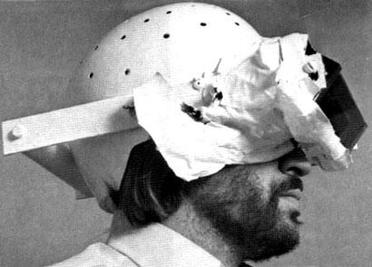 |
| George M. Stratton using the inverted world goggles |
A second point that I wanted to talk about is how D.T. Max discussed in his article "Swann’s Hypothesis" the research done by Jonah Lehrer to claim that smell and taste are our strongest senses. What is most impressive is that Lehrer was simply analyzing Marcel Proust's works thinking he would only find artistic data since "...artists are not interested in Science.". He then was surprised to have found neuroscience discoveries in his writings, making Proust an example of CP Snow's Third Culture. This theory discussed in the article is correct and the reason why it occurs is very interesting because it might be the answer to why writers and artists rely so much on their senses when creating art. Unlike other sensory tracts, our olfactory nerve travels directly to the frontal lobe without going to the thalamus first. It is the only sensory signal that gets to the brain before being processed by our sensory relay station (the thalamus). Then, from our temporal lobe, then signals travel to the thalamus where they are processed and sent to other parts of the brain for other functions. This is very important in relation to art. Our thalamus sends these signals to our limbic system, where you can find our hippocampus, which is where we store long term memory, and also our amygdala, which is our emotional processing system. This is the reason why scent not only triggers memories that were stored in the back of our brains, but it also creates an emotional response. Although Lehrer might say that Proust was the founder of this scientific fact because "His literary examinations teach him that smell and taste are the most intense of remembered sensations," I simply think Proust used his personal experiences with scent and taste on his writings for an artistic purpose, and didn't really feel the need to prove it to the world with scientific data.
| Human olfactory sensory system |
Finally, Professor Vesna talked about the use of drugs and its effect in our brains. In regards to this, I wanted to post some self-portraits created by an artist, Bryan Saunders, while being under the influence of 30 different drugs. Although his brain was not functioning appropriately, the paintings are still amazing and very unique. With this I just want to shown that our brain's interconnectedness, our sensory nervous tracts, and our brains ability to accommodate are just some of the reasons why art doesn't require our brain to be functioning appropriately, and more importantly, those suffering from any kind of mental disability can still be artists and create wonderful things.
 |
| Under Marijuana influence |
 |
| Under Cocaine Influence |
 |
| Under Morphine Influence |
 |
| Under Crystal Meth Influence |
Sources:
DeCharms, Christopher. "A Look Inside the Brain in Real Time." TED. March 2014. Lecture.
Deutsch, David. "A New Way to Explain Explanation." TEDGlobal. July 2009. Lecture.
"HOW YOUR SENSE OF SMELL WORKS." Neuroplasticity | Concussion | Rehabilitation | Orlando. Socialfix, 30 June 2016. Web. 18 May 2017.
Landau, Elizabeth. "What the brain draws from: Art and neuroscience." CNN. Cable News Network, 15 Sept. 2012. Web. 18 May 2017.
Lecture Video by Mark Cohen, Ph.D.
Max, D. T. "Swann’s Hypothesis." The New York Times. The New York Times, 03 Nov. 2007. Web. 18 May 2017.
Penkrat, Sophie. "How Removing Half of Someone's Brain Can Improve Their Life." Mental Floss. Mental Floss Inc., 21 Oct. 2015. Web. 18 May 2017.
Vilayanur, Ramachandran. "3 Clues to Understanding your Brain." TED. October 2007. Lecture.


Hi Paulina, I come from a similar background as you with the psychology and neuroscience classes. I have actually tried on those inverted goggles before and it is one of strangest experiences I have ever had. But I can definitely attest to how quickly your brain adjusts to normal vision when you take the goggles off. I also found your discussion of hemispherectomies to be very interesting and shedding light on the plasticity of the human brain and it's ability to compensate for lost functions. It's truly amazing! I enjoyed your point on how even if parts of our brain are not functioning properly, it does not mean the ability to produce art is lost.
ReplyDeleteI really enjoyed reading about how you say the brain can adapt. I strongly agree with this; frankly, I think it's amazing that our brain is so capable of adapting, that even if half of it is removed, it can still adapt to function normally! It is truly remarkable how resilient our bodies are. Your examples of art while under the influence of drugs is especially intriguing. I agree that just because our minds may not be working as they normally do, this does not impair an artists ability to create art because art comes from within.
ReplyDelete